Carmy is a brilliant young chef. Oozing the confidence and composure of a cook trained in the world’s finest kitchens, he is putting the final touches to a new dish, which he presents to his head chef. The dish is elegant and refined, with contrasting colours and complementary shapes. The dish’s construction conveys a sense of volume and texture and is immaculately presented in the centre of a white plate, the negative space emphasising the bold greens of the sauce and garnish.
Despite the dish’s appearance and with no consideration to its taste, the head chef is less than impressed:
“what the f*ck is this sh*t? It’s way too many components – you’ve basically made nachos”
Betraying no emotions, Carmy fills the silence by tidying away his creation. The head chef, meanwhile, reaches for some green sticky tape. He cuts a small piece, and with Cary looking on places it on Carmy’s work station:
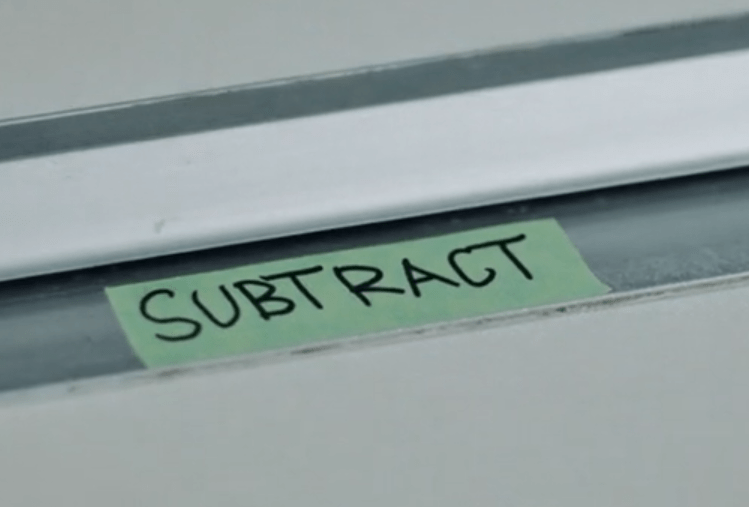
“that’s how you do better”, he says.
***
I get to visit a lot of schools, and work with a lot of leaders and a lot of teachers. I love this work. I always learn from my visits, and hope that I can reciprocate the benefit that I receive through the feedback that I offer. Whilst the visits often have unpredictable elements, there are some things I can almost guarantee I will find myself saying to school leaders, and one of those things is
“you are trying to do too many things. Subtract – that’s how you do better”
***
There are lots of things schools need to do. Lots of things that teachers need to do. Lots of documents, lots of policies. Lots of skills, techniques and microbehaviours. Some of these are “easy,” but many are not. They require time, effort, reflection and iteration. There is a gap between “hearing about the thing” and “doing the thing” – a gap that cannot be simply bridged.
Too often, school leaders assume that all that’s required is to “say the thing” or “write the thing.” To have done an inset on the thing or to have written a policy about the thing and magically the thing is now in play. Too often, school leaders are wrong, and the never-ending deluge of new ideas, policies and initiatives doesn’t result in a coherent school humming along in harmony. Too often, it results in a cacophony of individual teachers doing their own thing in their own classroom, some doing policy x, some doing policy y. Some following curriculum A and some following curriculum B. Incoherence and inconsistency abound.
Most schools have what I often call a de jure authority – a system of policies and rules that are decided centrally, written down and communicated to staff. However, despite the de jure authority, there is a de facto autonomy. The “rules” might be to do x, but the “reality on the ground” is that teachers are doing all sorts of things, and almost always not-x.
There are many causes for this phenomenon, but the most strident for me is simply the sheer number of things that teachers are asked to do. If a teacher – being human – cannot understand and intellectually integrate all the different things you are throwing at them, they certainly won’t be able to execute them.
I often see incredibly detailed teaching and learning policies, covering a huge range of teaching activities. I’ll look at it at the start of the day, and I’ll look at it after I’ve seen some lessons, and I’ll say to leadership I appreciate that this is what you want people to do, but they are doing barely any of this. It’s not their fault. They are only human. You’ve asked them to do a million things, and dedicated half an hour training to the whole lot at the busiest and most overwhelming point of the year, and you’re surprised they aren’t doing it? Subtract – this is how we do better.
Cognitively, it’s impossible to execute all of these plans. I get told to do a Do Now that has retrieval practice, that every lesson needs an oracy component, that I need to put “I do, we do, you do” on all my slides, do a turn & talk, give my students opportunities for metacognition, that students peer assess in green pen, self assess in red pen, and I mark in purple pen, that lessons need to be connected to the school-wide cultural priorities, that I need to do SLANT or STAR, to Cold Call and use mini-whiteboards, to coach and to be coached, to include a visualiser but also the branded slides, group work, an opportunity for creativity, to write a curriculum map and intent statement, to print and update my careers posters, that I need to hold back all my students till their shirts are tucked in at the end of the lesson, that my medium term plans need clearly delineated learning outcomes for every lesson, to write hinge tasks and multiple choice questions, to give exactly 40 minutes of homework a week, relational practice, restorative practice, trauma informed practice…the list goes on.
It’s also impossible for leadership to monitor any of this meaningfully. We end up falling back on poor proxies for learning, and annoying teachers by focusing on things they haven’t thought about or been reminded of for months. Teachers begin to roll their eyes and grow sceptical – here we go again.
Your “star” teachers try and do it all. They either burn themselves out or implement techniques without a full understanding of their parameters, and their lessons actively get worse because of training you have delivered. Everybody else ends up just ignoring it, and that de facto autonomy becomes the norm: me, in my classroom, doing my thing. Not everything sticks, and often the trivial things are done, and the important ones not – I see a lesson with perfectly branded slides where students are calling out and messing around and not being challenged and I know that this has happened because we’ve thrown too many things, and we lose control over what sticks and what doesn’t.
You say to me “but I’ve said it – we did this, I keep having to tell people” and I say “I know, but you need to reflect. These aren’t bad people, and they aren’t stupid either. So take a step back and figure out where you’ve gone wrong. Have you done too much? Can you subtract? After all, that’s how we do better.”
I often tell people that at the school I am lucky enough to work in – The Totteridge Academy – the quality of teaching is genuinely through the roof. It’s incredible. But in the six years since I’ve been there, we have had just three whole-school teaching and learning priorities. We laser focus on just a few things at that level, and we don’t move on until they are nailed down. We revisit them if there’s a need to. Individuals might have other things they are working on, but I’ve been taught that the way to improve isn’t by constantly adding, it’s by subtracting.
The long and the short of it is that the education sector’s constant need to add things doesn’t work. If you try to do everything, you end up doing nothing. It’s hackneyed, but less is more. There’s no point introducing two things badly, when you could have introduced one thing well. Instead, have a philosophy of subtract. What things can I take away? What things do we actually not need? Does this thing that I want genuinely influence student outcomes, or is it window dressing? Have we embedded the last thing before moving on to the next thing? Study these questions carefully. Exercise extreme reluctance before doing anything new. Consider the justifications carefully, and whether this is the right time.
And remember, always remember – put it on green tape above your desk if you need to – subtract: this is how we do better.
 A Chemical Orthodoxy
Leave a comment