
Getting your lesson start right is about as important as it gets. Done well, it’s just 4 minutes of teaching that sets a positive tone and culture for the precious minutes to follow. Done badly, it can result in conflict and antagonism which only tend to be exacerbated as time goes on. I recently wrote a thread on Twitter about an explanation phase of my lesson, and people seemed to enjoy it so I thought I’d do a post about a lesson start I did this week.
The lesson started, as it always does, with students entering the room to a Whiteboard Quiz (Do Now) on the board:
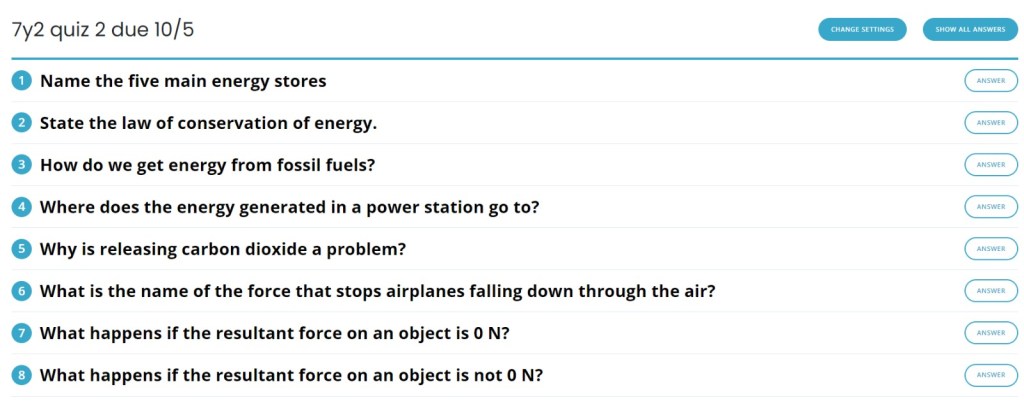
Why do I start my lesson like this?
- Settles the class into a familiar routine, they never need to waste time on procedural questions or figuring out what they are supposed to do
- The work is challenging but accessible, so all students will be able to work for 3 to 4 minutes minimum
- It’s good retrieval practice of content learnt over time
There is a fourth reason as well, which starts like this:
My students learn a lot of content over time. There is not enough lesson time for them to do retrieval practice on all that content on multiple occasions. So I set them lots of quizzes to do at home so that they get enough retrieval practice.
That makes sense, and we’re in a good routine with it, but I can’t be sure that they are doing their homework properly. I want to know that they’ve learnt from it, so I take some of the questions from the quiz and use those as my lesson starter on the day the quiz is due. This allows me to integrate the homework with the classwork and communicate its value to students. It also allows me to hold them to account for their performance, and see if they are just “doing” the homework or if they are actually learning from it (for more on this reasoning click here, and for more on how to turn this reasoning into a policy click here).
Once the students are settled and in Golden Silence, I call the register and quickly circulate to check a couple of students’ work. I pick students who I think are likely to be ones who are not doing the homework properly, but today the responses were pretty good.
The homework that students do is completed on Carousel, and once they have answered the quiz online, they self-assess. I then check their work and moderate their self assessment in the morning when it’s due. The students aren’t always as robust as I would like, so I quietly went to a student called Dave and said:
“When I was looking at your homework answers, you were far too soft on yourself. There were things you wrote that were definitely wrong or incomplete but you marked them as right. You know I don’t get upset when people get things wrong, I get upset when they aren’t honest with themselves. I’m going to check yours next time, and I want you to be as honest as I know you really are, ok?”
Dave got it, so I moved on. I saw that a few students had finished, gave them twenty seconds or so, then stopped them. Purple pens out, hold them up please so I can see – thanks. Went over the questions one by one, students self assessed in purple. Most of the questions were pretty straightforward and I used Cold Call to get answers from the floor. Question 4 and 6 were done by call and response (“what’s the answer to question 4, say your answer on 3…question 4 please: 1, 2, 3”) as they are super short and it’s a good way to pick up a bit of Ratio and get closer to the kind of whole class response you can get with mini-whiteboards. Question 5 I had to spend a bit more time on as a couple of students had written “it pollutes” (which is incorrect), so I noted that and I’m going to build it in to a future lesson (it isn’t necessary for today’s lesson which is about reproduction, and I’d rather do what I had planned).
I’d noticed in a previous lesson that student self-assessment following the Do Now wasn’t always up to snuff (e.g. putting ticks when answers were partially right, or crosses with no corrections) so I’ve been in the habit of asking students to hold up their books at the end so I can quickly see how much purple has been spilled. I then ask “hands up if you got question 1 correct…2 correct…” etc, so I can see if there’s anything I may need to reteach. This is much better than asking for “hands up if you got 8/8…7/8…” etc as a) it doesn’t embarrass anyone, b) doesn’t encourage them to say they got it right to artificially inflate a score and c) tells me which questions are problematic.
I asked the students why they thought I picked these questions in particular, and we noted that they were a selection of questions from their homework quiz. We discussed (again) the fact that it’s ok for them to get stuff wrong at home, but what isn’t ok is doing nothing about it. We don’t shrug our shoulders and say “I don’t know that and I don’t care”, we care a lot, and we don’t leave our computer until we’re ready to answer it in class as well. I say we discussed it again, because it’s a conversation we have a lot. I want them to actually learn from the homework, rather than just “do it”, so I need to hammer that message home a lot (Carousel users: you can very quickly and easily turn a Homework Quiz into a Whiteboard Quiz).
The students had done two quizzes at home, and the Do Now sampled questions from Quiz 1. For Quiz 2, I wanted to do a different style of follow-up work, so the first thing I did was have them get their mini-whiteboards out (17 seconds in complete silence, not our PB but not bad). I then showed this:
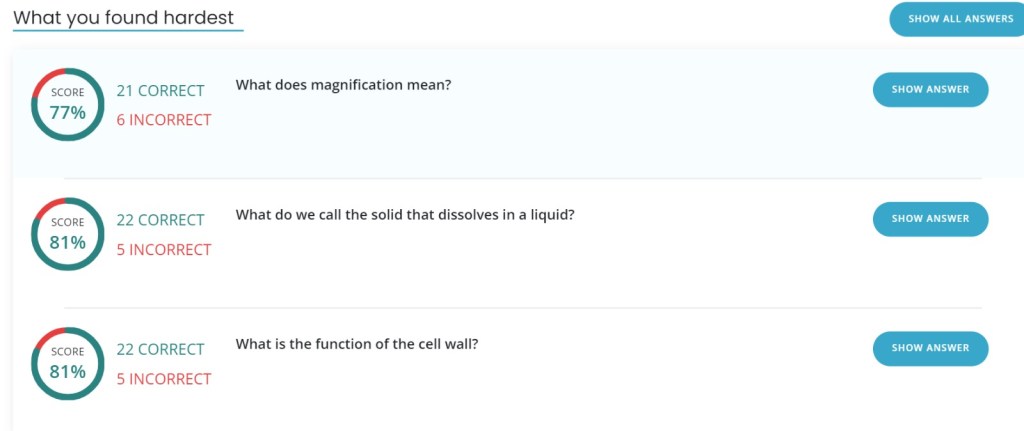
These are the three questions with the lowest scores at home. I want to know that they can answer them now, so I first ask them to do the second question on their boards (I’m going to come back to the first). I highlight the second question to make sure that they don’t miss a part of my instruction and auto-pilot to answering the first one. We do the next one on miniwhiteboards too, and I’m pleased that other than one or two students they all get them right (I note which students as I may talk to them later).
When I marked the students’ work and checked their self-assessment earlier in the morning, Carousel allowed me to highlight particular responses. These then show up as the next part of the Feedback screen, and they’re great for sparking discussion. For example, I put this up on the board:

When I first started doing this, I asked things like “what’s wrong with this” or similar, but now I’m really careful with my words. I don’t just want a sea of students giving me the correct answer. What I want is to excavate the error: this particular student has conflated “magnification” with “focus.” These are both processes to do with microscopes, and this conflation is an extremely common error and I want to tackle it head on and deliberately unpick the strands. So instead of saying “what’s wrong with this” I say “what was the student thinking of when they wrote this?” and get to have a great conversation with the class about the conflation. Nice.
Here’s a little table showing the remaining things I highlighted:
| Question | Answer I highlighted | Reason I highlighted it | Question I asked |
| Name five organelles that are present in animal and plant cells | nucleus cell membrane ribosomes mitochondria ribosomes chloroplast | Repetition indicates not having checked their work, substitution of chloroplast for cytoplasm is a common conflation | “what two things in this list need to be removed” “what could the student have done to make sure they didn’t repeat ribosome” |
| Give two properties of gases | random arrangement, not touching | This shows a confusion between properties (like whether the substance can be compressed or can flow) with its particle arrangement (random motion, not touching). This is one of the most important “big ideas” in chemistry. | “this [points] is a good answer to a different question. What’s the question that goes with this answer?” |
| Where are palisade cells found? | in the leaves | I prefer them to say “at the top of the leaves”. The student who wrote this had marked it as correct, when I expect more precision. | “this student marked this as correct, and I changed it to incorrect. Why did I change it?” “why does it upset me when students mark things like this as correct?” [I asked this to Dave via Cold Call to check that our conversation {which nobody else heard} had been properly understood] |
Doing this also further reinforces the message to the student that “I read and check all your work.” All too often we don’t convey this message enough, and students – rightly or wrongly – think “well, sir never checks it anyway so I’m not going to bother.”
After all that, it was time to press on with the lesson, and 18 minutes had passed since the students started walking through the door. A good use of time I reckon.
 A Chemical Orthodoxy
1 Pingback